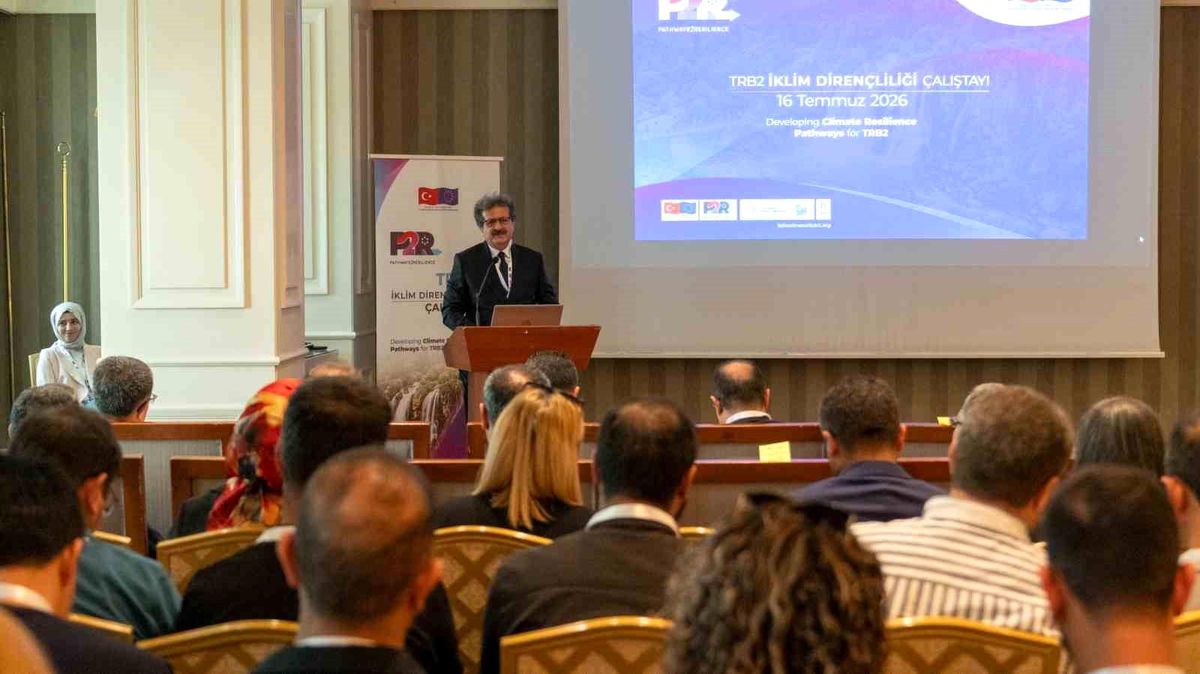
VAN (IHA) – Speaking at the "TRB2 Climate Resilience Workshop" held in Van, DAP Regional Development Administration President Halil İbrahim Güray stated that climate change in the city is no longer an environmental issue and said, "It is a multi-dimensional development issue that directly affects economic development, agricultural production, water resources, energy security, the welfare of our cities and societies."
The "TRB2 Climate Resilience Workshop", held within the scope of the "Development of the Climate Resilience Roadmap for TRB2 Project" carried out by the Eastern Anatolia Development Agency (DAKA), was held in a hotel in the city. Speaking at the opening of the workshop, DAP Regional Development Administration President Halil İbrahim Güray stated that climate change is no longer an environmental issue and said, "It is a multidimensional development issue that directly affects economic development, agricultural production, water resources, energy security, and the welfare of our cities and societies. Therefore, climate change adaptation policies have become an integral part of our regional development policies. With this project supported by the European Union, it is aimed to analyze the climate risks of our region with scientific methods, strengthen the adaptation capacity and create a long-term resilience vision."
"We shape our investment policies with sustainable development principles"
Stating that the EAP region has an important place in the development of our country with its rich natural resources, important water basins, large agricultural and pasture areas, high biological diversity and strategic location, Halil İbrahim Güray said, "It is also one of the regions that most intensely feels the effects of climate change such as drought, decrease in water resources, extreme weather events, erosion and natural disasters. For this reason, as the DAP Regional Development Administration, we shape our investment policies not only on the axis of economic growth, but also in line with the principles of climate resilience, protection of natural resources and sustainable development." spoke.
"Climate resilience is a fundamental condition for sustainable development"
DAKA Secretary General Mehmet Emin Çakay said that climate change is a global reality that directly affects agriculture, industry, water resources, energy, tourism, cities and quality of life. Çakay said, "The competitiveness of the regions and their resistance to climate change as well as the competitiveness of the regions have become one of the basic conditions of sustainable development. That is why, as the Eastern Anatolia Development Agency, we see climate change not only as an environmental issue but also as one of the main topics of economic and social development. From now on, we consider climate resilience, resource efficiency and sustainability among our main priorities in all the strategy documents we prepare and the programs we implement."
"Regions that can adapt will be the strongest regions of the future"
Emphasizing that the regions that can adapt to climate change will be the strongest regions of the future, Mehmet Emin Çakay said, "With this project we carry out within the European Union Horizon Europe Program, we will reveal the climate risks of our region with scientific methods, determine the areas of vulnerability, evaluate our adaptation capacity and prepare the climate resilience road map of our region with the participation of all our stakeholders. As DAKA, we will continue the activities that will ensure the development of our region, green transformation and shaping the sustainability ecosystem, as we have done so far. We believe that adaptation to climate change "Regions that can provide natural resources, protect their natural resources, and nourish and support this area with common sense will be the strongest regions of the future," he said.
Participating in the workshop, Prof. Dr. Abdulmenaf Turan also evaluated Türkiye's position on the international climate agenda and green development approach with his speech titled "Türkiye's Climate Diplomacy and Green Development Policies in the COP31 Process".
While the background and general scope of the project were explained by DAKA Program Manager Özgün Cümandür, Hakan Duman from the technical assistance team shared the implementation framework of the project, and Tamer Atalay shared the first data obtained within the scope of TRB2 climate risk analysis.
It was stated that in the afternoon part of the workshop, Project Coordinator Işıl Nadire Yener will provide information about the purpose, scope and activity process of the thematic activity groups and will carry out SWOT analysis in the thematic groups. -VAN