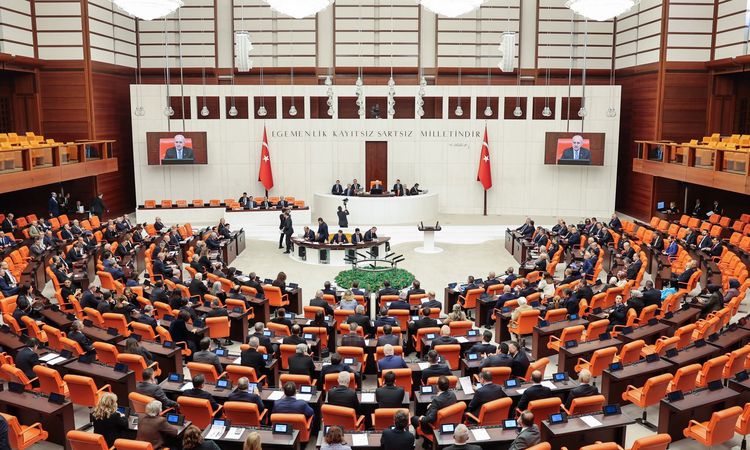
At the General Assembly of the Grand National Assembly of Turkey, the 'Proposal to Amend Certain Laws for the Effective and Efficient Functioning of the Judiciary', publicly known as the '12th Judicial Package', was accepted.
The General Assembly of the Turkish Grand National Assembly convened to discuss the 'Law Proposal on Amending Certain Laws for the Effective and Efficient Operation of the Judiciary', publicly known as the '12th Judicial Package'. The proposal was made after the speeches off the agenda, the 1-minute speeches of the MPs, the evaluations of the group deputy chairmen regarding the agenda, and the proposals submitted by the political party groups to the Presidency of the Turkish Grand National Assembly. As a result of the discussions, the proposal was accepted and became law.
By law, the first phase of the auctions for the sale of real estate that the owners have acquired by inheritance or where third parties other than the heirs do not have ownership rights will be held only among the heirs who are the owners. This auction procedure, which will be carried out only among the owner's heirs, will be done once. In addition, if the creditor who requests a sale in the announcement to be made in the electronic sales environment and wishes to participate in the auction applies to the enforcement office that carries out the sale within the day before the end of the auction period, the amount in return for the guarantee he must receive will not be taken, and the Treasury will be exempt from providing collateral. Bids to be made in the electronic sales environment will be based on 50 percent of the value of the seized property, and 100 percent of the estimated value in cases where the first auction in the liquidation of the partnership is made only between the heirs of the owner.
REGULATIONS ARE BEING MADE REGARDING THE NOTARY LAW
The law makes changes to the 'Notary Law'. In this context, notary documents and books; It can be examined by the court, criminal judgeship of peace, chief public prosecutor's office and official offices. If the original of the notary document is requested by the court, criminal judgeship of peace and chief public prosecutor's office, the relevant notary will make a copy of the document and confirm its conformity with the original. The notary will keep the approved copy on site and send the original document to the relevant authority. In cases where a certified copy of the notary document is requested by the authorized institutions, the notary will electronically transmit the certified copy created by scanning the original of the requested document and signing it with a secure electronic signature. In cases where it is not possible to send electronically, the document will be verified as original and the certified copy will be sent to the relevant authority. No journal number will be given for the transactions made, and no fees will be charged, including duties, taxes, and valuable paper fees, except for postal costs and travel expenses determined by the tariff.
THE SCOPE OF CASES THAT CAN BE RESOLVED BY A SINGLE JUDGE IN ADMINISTRATIVE COURTS IS BEING EXPANDED
The period for reducing the number of chambers in the Council of State by 10, which was given a 10-year period by law in 2016, will be extended for another 4 years. Thus, the number of chambers in the Council of State will not decrease. While the number of chambers in the Council of State will not decrease, the practice of electing one member for every 2 vacant memberships will be abandoned until 2030. On the other hand, regulations regarding administrative and tax courts are also being made. Accordingly, cases that can be resolved by a single judge in administrative courts will be expanded. Except for those filed against regulatory actions and full jurisdiction cases filed against administrative actions not exceeding 486 thousand liras, cases filed against disciplinary punishment and class passing, grade determination, dormitory, loan and scholarship transactions, except for those that result in suspension and dismissal of primary, secondary and higher education students, cases filed against temporary assignment, travel allowance, lodging and leave procedures for public officials will be resolved by one of the administrative court judges. In addition, cases not exceeding 486 thousand liras will be decided by one of the tax court judges.
REGULATIONS REGARDING REGIONAL ADMINISTRATIVE COURTS
On the other hand, the Regional Administrative Court will finally decide to annul the decision of the first instance court, which gave the decisions made upon the initial examination and other final procedural decisions, and to send the file to the court that made the decision. However, the Regional Administrative Court will be able to make a decision by correcting the deficiency itself in cases where a hearing should be held with discovery or expert examination, but a decision is made without a hearing. Apart from these regulations, it cannot be decided to revoke the decision and send the file to the court that made the decision. With another regulation in the Administrative Procedure Law, the decisions made by the Regional Administrative Court upon annulment of the decision of the first instance court in the appeal legal review, in cases other than the cases determined for appeal, can be appealed to the Council of State within 30 days from the notification. With the amendment to the Law on Certain Regulations Regarding the Forensic Medicine Institute, in order to be appointed as the chairman and member of the forensic medicine specialization board, it will be required to have at least a certificate of expertise in medicine or dentistry or a doctorate degree in the field. The term of office of the president and members of the forensic medicine specialization board, forensic medicine group presidents and forensic medicine specialization department heads will be 4 years. The duties of those whose terms have expired will continue until the newly appointed or assigned ones take office.
WARNING PENALTY WILL BE GIVEN TO JUDGES AND PROSECUTORS WHO APPLY TO AN EXPERT IN FILES THAT CAN BE SOLVED WITH LEGAL INFORMATION
With the law that rearranges the annulment decisions of the Constitutional Court, judicial assistant judges and prosecutors and assistant administrative judges will be given training on legal issues. In the written exams, questions will be asked from the subjects taught and will be evaluated out of 100 full points. The results will be recorded in the written examination board and delivered to the Turkish Justice Academy. In the oral examination, the assistant judges and prosecutors' knowledge of legislation, jurisprudence and practice on educational issues, professional competence, ability to understand, solve and express legal issues, self-confidence, representation ability and suitability of their behavior for the profession, ability to use Turkish effectively and general culture and talent level will be evaluated. If an expert is consulted on issues that can be resolved with the legal knowledge required by the profession of judge and prosecutor, a warning will be given.
THE UNDETERMINED CREDIT CASE PROVISION IS BEING RESOLVED.
On the other hand, within the scope of the law, the provision titled 'Uncertain debt lawsuit' in the 'Civil Procedure Code' is abolished. In cases where only a portion of the receivable is sued, the subject of the claim may be increased only once in the same case, until the end of the investigation, without being subject to the prohibition of expanding the claim. In this case, the statute of limitations will be deemed to have ceased as of the date of the lawsuit, also in terms of the increased part. The period between hearings cannot be longer than 3 months. In cases of necessity, such as the prolongation of expert examination due to the nature of the work or the conduct of investigation procedures through rogatory, the judge may determine a longer period by stating the reason. Provisions regarding handwritten signatures will not apply to those who are decided to attend the hearing from where they are by audio and video transmission, except for the cases of confession, taking of the oath, consent to withdrawal of the case, waiver of the case, acceptance of the case and settlement. This provision will enter into force 3 months from the date of publication of the regulation.
In addition, the law regulates those who share their bank account information with others for unfair advantage, known to the public as 'IBAN victims'. If the participation in fraud and qualified fraud crimes is limited to the act of giving someone else the compulsory information or tools that enable the use of payment instruments such as a bank or credit card belonging to one's own or someone else's bank or credit card, or the account at the bank, intermediary institution, payment service providers or crypto asset service providers, in order to gain an unfair advantage for oneself or someone else, the penalty to be imposed will be reduced by half. Among the defendants who have been convicted of fraud or aggravated fraud before the date of entry into force of the law and whose files are under legal review, a decision to overturn the files of the defendants to whom the added paragraph applies will be given in the criminal chambers of the regional courts of justice, and the file will be sent to the first instance courts. The files in the Supreme Court of Appeals Chief Public Prosecutor's Office will be forwarded to the first instance courts in accordance with the procedure upon arrival.
After the proposal became law, Parliament Deputy Speaker Pervin Buldan closed the assembly to meet on Tuesday, July 21.