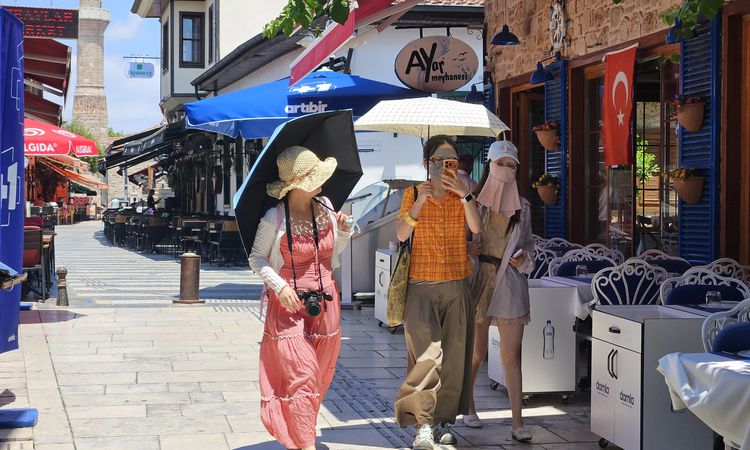
In ANTALYA, Far Eastern tourists exploring the streets of historical Kaleiçi in temperatures reaching 36 degrees Celsius are even covering their faces to protect themselves from the sun.
During the peak summer tourism season, while Russian, European, and Scandinavian tourists swim in the sea on Antalya's beaches, tourists from Far Eastern countries such as South Korea, Japan, and China prefer historical and natural sites like Kaleiçi, Cappadocia, and Pamukkale. Far Eastern tourists also cover their faces, in addition to using umbrellas, hats, and long-sleeved clothing, to protect themselves from the sun.
A group of female tourists from the Far East, attempting to cover their bodies, arms, and faces as much as possible to prevent sunburn, were seen in Kaleiçi, Antalya's historical center. The tourists, exploring historical and cultural sites in the hot weather, were observed using umbrellas, long-sleeved clothing, and mask-like products to cover their faces.
Fatma Yaylalı, Branch Manager from the 4th Regional Directorate of Meteorology, stated that air temperatures in Antalya are hovering between 32 and 36 degrees Celsius, which is within seasonal norms. She added, "During summer days, between 11:00 AM and 4:00 PM are the hottest hours of the day when sun rays are most direct. We advise our elderly, patients with chronic illnesses, and children to be more careful and cautious when going outside."
On the other hand, it is stated that genetic factors, cultural habits, and skin structure lie behind the preference in Far Eastern countries not to get sunburned or reddened in the heat. For people from the Far East who protect themselves from sunlight due to sensitivity to skin blemishes, fear of premature aging, sun allergies, and burns, white and smooth skin is seen as a symbol of a rebellious, youthful, and clean appearance, while tanning is perceived as the look of the lower class or field workers.