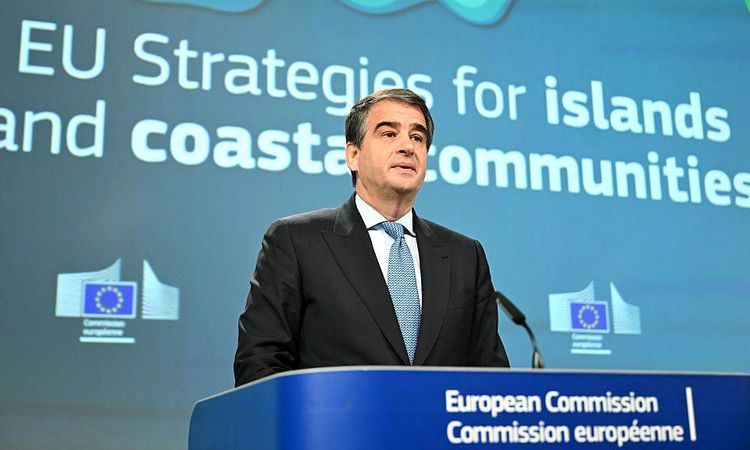
European Union (EU) Commission President Ursula von der Leyen's appointment of Vice President Raffaele Fitto as Cyprus Special Representative brought about controversy.
With this appointment, the EU has taken its efforts to be at the table in the solution of the Cyprus problem to the next level.
Türkiye, on the other hand, sees this appointment within the EU, which it accuses of not being impartial in solving the problem, as an "internal matter of the EU".
The appointment coincided with a period when the United Nations (UN) was intensifying its efforts to solve the Cyprus problem and new possibilities were being discussed.
In her social media message, Von der Leyen stated that "they are ready to do everything they can to support efforts to resolve the Cyprus problem within the UN framework and in accordance with the principles, values and legislation of the EU."
"There is real momentum to make progress. The EU is fully engaged in this process. Together, we will work to seize this opportunity," von der Leyen said.
In the written statement made by the EU Commission regarding the appointment of Fitto, it was said: "This decision reflects the Commission's strong determination towards the reunification of Cyprus in order to ensure a functional and sustainable comprehensive solution."
Italian Foreign Minister Antonio Tajani also expressed the opinion that Italian parliamentarian Fitto is the most suitable person for the task due to his "mediation skills and knowledge of the problems facing the Mediterranean, especially considering the challenges that need to be addressed."
Fitto's appointment has remarkable dimensions.
The first of these is that Fitto serves as the Vice President of the EU Commission.
His predecessor, Johannes Hahn, is a former Commission member.
The view that the office of Fitto, who is one of the names suggested to Brussels by the President of Cyprus Nikos Hristodulidis to Brussels, adds institutional weight to the duty of special representative, stands out.
There are many people who think that the appointment of Fitto, one of the names at the highest level of the Commission's institutional hierarchy, has made the EU more active and ready to engage in the process of solving the problem.
It is also noted that Fitto has the potential to easily move the Cyprus issue to the top of the Commission's agenda.
Ensuring that the EU somehow takes part in the process of solving the Cyprus problem and does this with a strong engagement at the highest possible level is seen among the policies followed by the Cyprus administration from the beginning.
Fitto's appointment is considered an indication that this policy is bearing fruit.
Fitto is not a name completely distant from the Cyprus problem.
As Deputy Chairman of the Commission, Fitto's duties include monitoring the processes regarding the unification of Cyprus led by the Commission, strengthening the social and economic conditions of the Turkish Cypriot community in the context of the aid program and implementing the Green Line Regulation.
Fitto will work closely with UN Special Representative for Cyprus Maria Angela Holguin.
In his message regarding the appointment, Fitto stated that he "aims to create the necessary conditions for the resumption of negotiations, including the establishment of trust between all stakeholders and the negotiating parties, and to support the achievement of a comprehensive and lasting solution."
Especially after the talks in Crans Montana in 2017 failed, Türkiye took its approach to solving the problem to a different line.
Ankara is of the opinion that the sovereign rights of Turkish Cypriots can only be secured with a two-state solution.
The EU flatly rejects this approach, with the direct effect of Cyprus being a member of the Union.
The UN's approach and framework to the problem is not close to the idea of a two-state solution.
However, Ankara continues to see the UN as the address for the solution. He does not favor the intervention of actors who have no direct connection with the issue.
The special representative appointed regarding the EU and the Cyprus issue is also evaluated in this way. The latest appointment is seen by Türkiye as an "internal matter" of the EU.
Türkiye is of the opinion that although it was the Greek Cypriots who said no to the Annan Plan in 2004, the EU lost its neutrality regarding the problem with the inclusion of Cyprus.
Making a written statement regarding Fitto's appointment, the Ministry of Foreign Affairs used the following statements:
"We expect the newly appointed official of the European Commission to make efforts to change this biased attitude of the EU and to realize that the solution to the Cyprus issue can only be achieved through negotiations between two sovereign and equal states, on the basis of the facts on the Island."
Hahn, the EU Commission's first Special Representative for Cyprus, served as Enlargement Commissioner for a term.
Hahn could not establish a positive relationship with Turkey during this duty.
Hahn was not accepted as an interlocutor by Türkiye from May 2025, when he was appointed as Special Representative, until March 2026, when he resigned during the Cyprus EU Presidency.
Türkiye has no obvious problem with Fitto.
However, the view that comes to the fore in diplomatic circles is that it is unlikely that Türkiye will be addressed with the title of Special Representative.
The Cyprus issue is among the most important obstacles to the progress of Türkiye-EU relations.
The EU has linked the progress of Ankara-Brussels relations with the solution of the Cyprus problem.