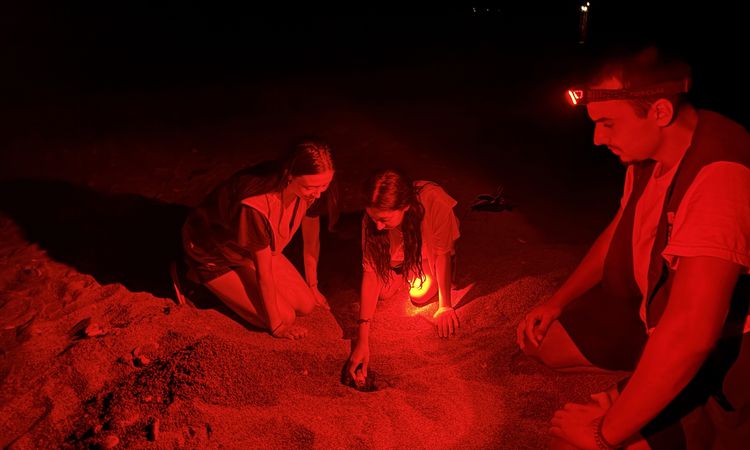
The activity started in 2021 within the scope of research on the effects of climate change on the gender of sea turtles on the Çıralı coast in Kemer, ANTALYA, has come to an end. The scientific results of the research will be announced at the end of this year's nesting season by examining the data collected by temperature meters called 'Data loggers' placed in the nests. Prof. who conducted the study. Dr. Bektaş Sönmez said, "Since sea turtles do not have a sex chromosome, environmental factors determine their gender."
The nesting season of 'Caretta caretta' and 'Chelonia mydas' species of sea turtles, which are on the red list of endangered species of the International Union for Conservation of Nature (IUCN), continues on the Turkish coast of the Mediterranean. The number of nests reached 84 this season on the Çıralı coast, one of the most important of these areas, where protection and monitoring activities are carried out with the protocol signed between the 6th Regional Directorate of the General Directorate of Nature Conservation National Parks (DKMP) and Ulupınar Environmental Protection Development and Management Cooperative. In Çıralı, Ulupınar Environmental Protection Development and Management Cooperative scientific advisor, sea turtle expert Prof. Dr. 'Data logger' was placed in the slots by Bektaş Sönmez. With these, the effect of climate change on the gender formation of the offspring will be scientifically monitored by monitoring the sand and nest temperature throughout the incubation period. The results of the activity carried out at the end of this period, which is the 5th and last year, will be announced in a scientific article.
Scientific advisor, sea turtle expert, Prof. working at Sivas Cumhuriyet University Suşehri Timur Karabal Vocational School. Dr. Bektaş Sönmez said, "Çıralı is an important beach for sea turtles. Activities have been carried out for many years to determine the population here and its current situation. Our hypothesis is, 'I wonder what will happen on this beach, gender change and gender prediction.' We started an experiment in 2021. We started an experiment in 2021. Taking records with temperature meters in 10 nests every year and reaching a total of 50 nests as a result of these records, estimating how many females and how many males joined the population through these 50 nests. Why do we do this? Because sea turtles do not have sex chromosomes, environmental factors determine their gender. Typically, when the pivotal temperature of sea turtles exceeds 29 degrees Celsius, the number of individuals leaving the nest becomes female-dominated. As the temperature drops below 29 degrees Celsius, a male-dominated population emerges. Now, as a result of climate change, our beaches and coasts have started to warm up. As a result, we can have a population with uniform genders. "Of course, this is a serious risk for the future of the species and the species may become extinct," he said.
'WE PLACE THE TURTLE INSIDE IT AFTER IT HAS LAYED IT'
Providing information about the devices placed in the slots, Prof. Dr. Bektaş Sönmez said, "We have temperature meters that we call data loggers. These are programmed before they are left in the nest. After making the program, it has an interface program that we connect to our computer and then we want it to measure the temperature at certain intervals, such as hourly, 90-minute, 30-minute, 5-minute, etc. We wanted hourly measurement here. In other words, we wanted to record 24 readings per day from each nest, and we accumulated it and used it to obtain the average values in the total incubation period. However, the sensitive point here is; determination of gender." The temperature that determines the sex is the middle third of the incubation period. In other words, when we divide the incubation into 3 parts, we decide the temperature in the middle third period based on the temperature in this area, which is above and below 29 centigrade. When we detect the nest, we usually place it in the evening, after the turtle has laid eggs, and we turn it off. From that moment on, the data logger starts measuring the temperature at the end of the season. "After the incubation is completed, it is removed from the nest, transferred to the computer, and the data there is taken and standardized through the interface. After the beginning and end of the incubation are sorted, we have the temperature records we took for each hour during the incubation period of that nest. These are synthesized, and we can get an idea about the gender of that nest by using these formulas to estimate the sex ratio."
Habib Altınkaya, President of Ulupınar Environmental Protection, Development and Management Cooperative, said, "We are in the field as a cooperative, based on the protocol we made with the General Directorate of Nature Conservation and National Parks. We have 8 volunteers and currently 4 employees. We are carrying out protection monitoring activities in the field with the support of Sivas Cumhuriyet University. As of this year, we have 84 nests. Last year, we had 124 nests. Hopefully, we want to continue exceeding the number of nests of last year."