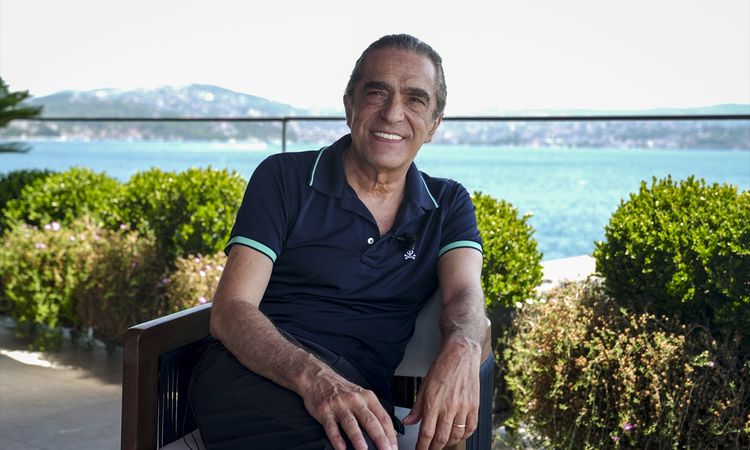
Artist Fahir Atakoğlu stated that he focused on people in his work "July 15 Epic", which he composed about the coup attempt of the Fetullah Terrorist Organization (FETO) on July 15, 2016, and said: "What a Turk did to a Turk, what a brother did to a brother... I wrote those songs to prevent all this from happening again and to look at it with the eyes of my heart." he said.
Composer and pianist Fahir Atakoğlu, in his statement to AA correspondent on the 10th anniversary of the July 15 coup attempt, said that the meaning of the work has not changed for him despite the years that have passed.
Stating that he was thinking about the pain and the trauma experienced by the society while writing the work, Atakoğlu said:
"When I wrote the Epic of July 15, I thought entirely of humanity. How the Turkish people were forced to collide with each other like this, how our eyes were forced to look at the sad scenes. They impressed me. The priority for me was always the human being, what the human being was. From then until now and afterwards, those melodies were listened to and remembered, so that what man did to man should not be repeated again. What the Turk did to the Turk, what the brother did to the brother... I wrote those music to prevent all this from being repeated again and to look at it with the eyes of my heart."
Atakoğlu emphasized that he tried to put himself in the shoes of the people who lived those moments, even though he was not involved in the events while creating the work, and said, "There was a chronological narrative from the first moment to the last moment. There were emotions such as what would happen if I were there or if I were there, how would I feel." he said.
Pointing out that art plays an important role in learning lessons from the past, Atakoğlu said, "I think art and every aspect of art are very important for us to learn some lessons from history and move towards the better. I guess the place of art is eternal for him." he said.
Fahir Atakoğlu stated that music is one of the powerful tools that keep the collective memory of societies alive and said that art appeals to people's common emotions.
Noting that art contributes to not forgetting historical events, the artist said, "Music is something that goes to the heart. We all have emotions, we are all human. What we all have in common is emotions. Art appeals to emotions and the heart. That's why it becomes a common language." made his assessment.
Atakoğlu stated that social events should be transferred to future generations not only through music but also through all branches of art.
Stating that such historical events should be tried to be kept alive not only with music, but also with paintings, books and poetry, Atakoğlu noted that art is very important in this sense.
Stating that the music he made for documentaries also contributed to the memory of historical events, Atakoğlu said, "The power of art is endless. That is why music, compositions, lyrics, pictures and books will always be reminders of such events and will keep them alive so that we do not forget." made his assessment.
He brought the exile of Meskhetian Turks to music
Atakoğlu pointed out that he recently composed music for an exhibition about the exile of Meskhetian Turks and said that this activity aimed to contribute to social memory.
Stating that the tragedy experienced by Meskhetian Turks is not well known, Atakoğlu said:
"Recently, an exhibition of Meskhetian Turks was held and I made music for that exhibition. It was also a very nice project because Meskhetian Turks are not actually a very well-known history in our society. It was a good opportunity for it to be revealed a little more. I tried to explain this adventure and exile life of Meskhetian Turks with this music."
Stating that such activities allow him to produce permanent works, the artist continued as follows:
"I am also lucky as a composer because coming up with such topics enabled me to produce very qualified and lasting works. Frankly, I love doing such works. While doing all this, I really try to express what I feel. Not to make others feel. I write what I see and feel as a human being. People like it too."
Fahir Atakoğlu stated that composing is the art of establishing a common feeling with the listener and said, "Hopefully, when that music is remembered years later, it will be remembered together with the Meskhetian Turks and shed a light in history." he said.
"The persecution of the Palestinian people is shameful"
Emphasizing that the situations experienced in the world directly affected his productions, and that especially the events in Palestine left a deep mark on him, the artist made the following evaluations:
"What is happening in Palestine right now and the persecution of the Palestinian people is shameful as a human being. Of course, it affects everything you do. If I am making music for a TV series today, what is happening there awakens something in me to express the human, the sadness or grief. There is no way you can't not feel it. You don't just have to be an artist, if you are a sensitive person, there is no way you can't not see and feel that massacre, that genocide. We are experiencing the worst thing in the world right now."
Underlining that he tries to touch people's emotions through art, Atakoğlu said, "While doing all this, 'What can I do as an artist? How can I help?' "When you say this, maybe nothing physical happens, but only my duty can be to instill, give and make people experience that feeling in your writings and melodies." he said.
Stating that he plans to present the work he prepared for Meskhetian Turks to the audience abroad with live performances, Atakoğlu explained that he is working on the music of the "Alesta" series prepared for the TRT Tabi platform, and that he also aims to bring the music of the "Magnificent Century" project to the stage in a concert format.
The artist added that he wanted the work called "100", which he composed for the 100th anniversary of the Republic, to be performed by symphony orchestras in different cities of Türkiye.