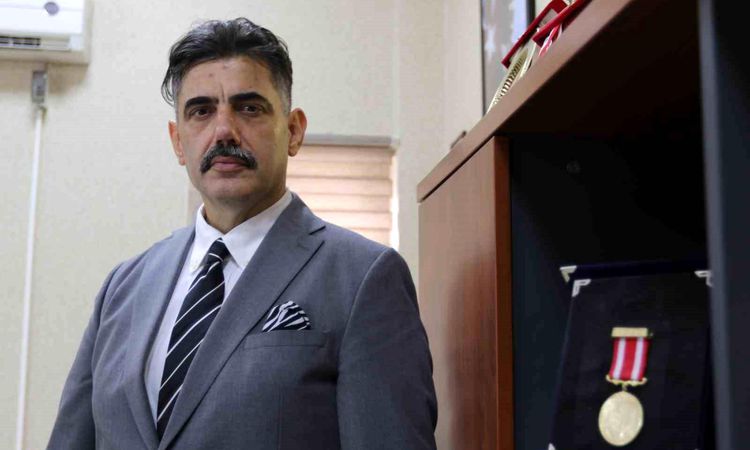
51-year-old Superintendent Murat Ellibeş, who was shot while trying to save his friends who were taken hostage in Istanbul during the coup attempt of the Fetullah Terrorist Organization (FETO) on July 15, 2016, and became a veteran, talked about the betrayal that took place that night and the resistance of the nation. Describing the dialogue he had with a coup captain after he was shot, Ellibeş said, "He asked me, 'Are you their chief?' he asked. 'Yes, I am the chief. I am the police, you are the soldier. What is this hostility?' "When I asked, I heard a sentence: 'We have nothing to do with you, with the management'," he said.
51-year-old veteran Chief Inspector Murat Ellibeş, who regained his health after his successful surgeries and returned to his duty and currently serves as Office Chief at the Izmit District Police Department, talked about his experiences on July 15.
Stating that he worked as a deputy commissioner at the Istanbul Provincial Police Department in 2016, when the coup attempt took place, Ellibeş said, "I was working as an implementation supervisor at the Tuzla Mehmetçik Foundation on the evening the coup was planned. That evening, I served as the head of a team of 17 people. In the following hours, our friends said that there was movement, there was some news on television, the throat was closed and they could not understand. We tried to contact our superiors, but there was a lot of radio traffic. We took precautions ourselves." "We tried to get information and followed the news. Meanwhile, we were asked to go to Tuzla District Police Department, we left our 5 friends and went towards Tuzla District Police Department."
"If anyone wants to come with me, come, but this is not an order."
Stating that when they arrived at the Tuzla District Police Department, they received information that their colleagues at the Mehmetçik Foundation they left behind were taken hostage, Ellibeş said:
"Thereupon, we left the Tuzla District Police Department to go to the scene. When we arrived, reinforcements arrived, but we saw that there was no movement towards the place where there was a hot conflict and our friend was taken hostage. I said that our friend was in a difficult situation, that is why we had to go there. But our friends said that this would not be the right move because there were long-barreled weapons there, and we had short service pistols, we would be weak in case of a response and we should wait for reinforcements. I will go as an initiative. I said, 'If anyone wants to come with me, come, but this is not an order.' 5 of our friends came with me voluntarily. We got into the vehicle and moved towards that direction."
"My feet were tied and I fell backwards"
Ellibeş explained that when they arrived at the scene, they encountered a military student on the other side of the lane who was acting aggressively with a long-barreled gun in his hand, and that he was shot while warning him, and continued his words as follows:
"On the opposite side of the lane, a military cadet was making aggressive movements left and right with his long-barreled gun. But there was no other soldier-looking person around. This caught my attention. While I was telling this cadet that what he was doing was a crime and that he should lay down his weapon, before I could finish my sentence, we heard a gunshot. As I later learned, the shot was fired by the soldier-looking traitor who took a position behind the truck trailer. After a while, the friends said, 'Shooting was opened. Our commissar was shot, but he was not shot.' He said things like: "I was wearing a steel vest. I had a rash on my abdomen, but there was no blood. I said, 'I guess it was a blank shot.' Then my feet were untied and I fell backwards. 'What are you doing?' When I heard voices, I turned around and tried to understand the incident. When I turned my head behind me, I saw that all 5 of our friends were surrounded and laid on the ground with rifle butts. Before I had time to think, "I hope we don't cause any casualties, it doesn't get worse," voices started to rise from where the citizens and cars were stopped. I heard them. 'You killed, what are you doing?' "I heard voices like this."
"I am the police, you are the soldier; what is this enmity?"
Stating that he had a gun pointed at his head when he was shot and fell to the ground, Ellibeş said, "He asked me, 'Are you their chief?' he asked. 'Yes, I am the chief. I am the police, you are the soldier. When I asked, "What is this hostility?" I heard a sentence: "We have nothing to do with you, with the management." Meanwhile, he was trying to press me towards my back, towards my abdominal area. I couldn't understand it, but as far as I understood later, he said I had a gun on my waist. Of course, I read these from the statements later. I was at the stage of losing myself at that moment. He tried to take my gun, but he couldn't because I was lying on top of him. Citizens also reacted intensely. 'Are you going to kill? What did you do? After he said, "You shot the man, he is dying," he said, "Get him out of here." "From what I saw, he had three stars, a traitor soldier with the rank of captain," he said.
He was transported to the hospital in a vehicle whose tires were shot.
Ellibeş, who lost consciousness after being injured and was carried to a civilian vehicle by his colleagues, could only be transported to the hospital by a vehicle moving on rims because the traitors also shot at the tires of the vehicle.
Stating that he had a critical surgery that lasted about 6 hours and that the recovery process took 6 months both in the hospital and at home, Ellibeş stated that he received great support from the public and said, "There was a lot of kindness. There was a lot of interest from the citizens. That's why, unfortunately, we got an infection, even if unintentionally. I had to receive treatment in the hospital again."
"Our citizens who took to the streets had love of their homeland in their minds and faith in their hearts."
Underlining that they fulfilled their primary duty with their stance that night, veteran Chief Inspector Ellibeş concluded his words as follows:
"That evening, we fulfilled our duty. This is our primary, professional duty. Our citizens contributed a lot to us there. Our citizens who took to the streets had love for their homeland in their minds and faith in their hearts. By writing the July 15 epic as citizens, this nation proved to the whole world how it is not easy to surrender a country that wants to be shackled. We say 'Thank you for the homeland'." - KOCAELİ