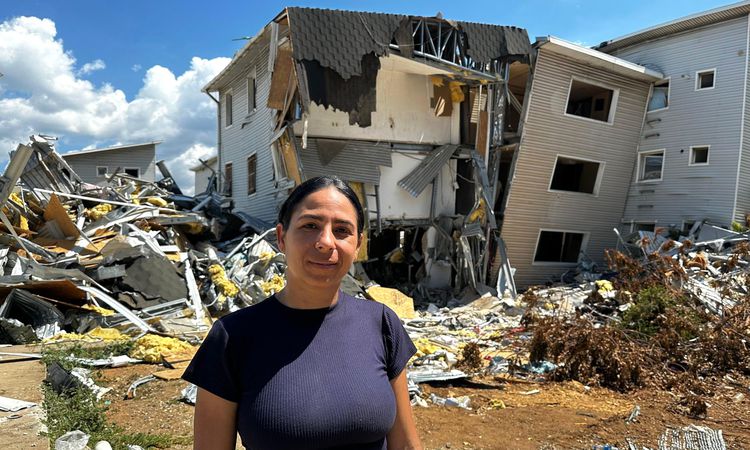
Karolyn Sanchez is sadly and hastily collecting the few remaining belongings from her home in the Hugo Chavez public housing complex, also known as Ciudad Chavez, located in the Playa Grande neighborhood of La Guaira, Venezuela's most important port city.
Karolyn's house was on the third floor of one of the 196 four-story buildings on campus.
After the two most devastating earthquakes in Venezuelan history on June 24, Sanchez's apartment sits on a pile of rubble. The 37-year-old woman calls me from inside the house because she can't get too close to the window. The building is leaning so much that it could fall if it got close to the window.
The rubble on which the remaining part of the building from the earthquake stood was actually the ground floor. It looks as if the ground has opened up and the ground floor has gone inside.
Karolyn shows me the wound on her hand from the window and screams that she was injured trying to climb into her apartment.
He spent the last few hours trying to salvage his few possessions. He was able to remove two gas cylinders, some clothes and kitchen utensils. His face covered in sweat, he says he would welcome any help to save the rest.
He leaves the building as expertly as he entered. He passes through the windows, avoiding sharp pieces of debris and finding his way among the bent remains of the stairs.
"Seven people died in this building," he says, and then bursts into tears; "It's not easy."
He says some people were pulled from the rubble by relatives and neighbors.
"Many people worked for hours and days to save people."
Karolyn went to Colombia to work four months before the earthquakes.
He wanted to save money to renovate his apartment. As soon as he learned about the disaster, he spent his little savings on the bus from Bogota to Caracas.
“People say material things can be replaced, but maybe they don't realize how hard a person works for years and decades to have those items,” he says with difficulty.
Sanchez remembers the joy he felt when he was given a one-bedroom apartment in a 3,200-home development called Ciudad Chavez in 2013.
This was a huge situation for her and her two children at that time. He now has four children.
After losing their home due to rain and floods that hit La Guaira in February 2005, they took shelter in a makeshift place in Camuri Chico, east of La Guaira, for five years.
At the time, this was his second time being homeless; His family also lost everything in the Vargas landslide in 1999. Thousands of people lost their lives in that disaster.
During his visit to the region in August 2012, then-President Hugo Chavez said in a national radio and television broadcast that the project consisting of 196 blocks represented the "Bolivarian Revolution" and said, "Quality flats and residences, and they were subsidized."
In the same speech, Chavez emphasized that this "miracle" was possible thanks to the cooperation with Türkiye and the Summa company responsible for the project.
Chavez did not see the project completed. He died due to cancer in March 2013.
His successor, Nicolas Maduro, inaugurated part of the campus a little more than a year after Chavez's visit.
That's when Karolyn received the keys to her new apartment.
He remembers seeing Maduro at the ceremony and everything was "so beautiful."
The Hugo Chavez compound was part of the Greater Venezuela Housing Mission, one of the former president and Bolivarian government's most iconic projects.
The program was launched in 2011 with the promise to build millions of social housing units for the most disadvantaged segments of Venezuelan society.
The government says more than five million homes have now been delivered under the mission, under the leadership of interim President Delcy Rodriguez. Their opponents question these data.
15 years after its inception, the program is under scrutiny as many structures along the coast of La Guaira were severely damaged or completely collapsed during the June 24 earthquakes.
Most of these structures were part of OPPE (Presidential Office of Special Plans and Projects) projects in Caraballeda and Ciudad Chavez in Playa Grande.
It is estimated that approximately 80% of the 196 buildings in the complex collapsed or were severely damaged. The remaining structures will probably need to be demolished.
Two earthquakes of magnitude 7.2 and 7.5 occurred in Venezuela on June 24, approximately 40 seconds apart.
The materials used in the construction of Ciudad Chavez, which could not withstand this size, are now a matter of debate.
Karolyn, who has lived in these buildings for more than 10 years, thinks that the buildings are not strong enough to bear the load they carry.
"The material wasn't suitable. They weren't strong enough to support that much weight," he says.
"They looked like they were made of cardboard. They had drywall and I think fiberglass in them, which are not suitable materials for the weight they were carrying," he continues, pointing to the debris where twisted steel and bits of wood and plastic were visible.
Due to frequent water outages in La Guaira, many residents had placed large water tanks on the roofs of their buildings.
Some residents had also renovated their apartments, adding more weight to the structures with ceramic floors, veneers or brick applications.
Enyerber Pernalete, 44, now sells cigarettes in front of the rubble of what used to be his home.
From there, he looks out over what's left of the I-10 Block. He credits the tiling job he did on his apartment years ago with saving his life.
"The left side of the building completely collapsed, but where I lived remained standing," Enyerber says.
Enyerber lived on the ground floor with his wife and three children. He and his family escaped unharmed, but he is saddened by the deaths of many of his neighbors.
"I had bricks everywhere. The whole flat was covered with bricks," he explains; "Mice get into the drywall a lot, so I covered it with brick to keep the animals from getting in."
"I'm almost sure that the part above my flat didn't collapse because of the bricks I put in. In my opinion, without them, those four floors would have completely collapsed."
He also thinks the original design was not planned to handle subsequent changes.
"It's all drywall. The upper floors were not designed for tiling or installing water tanks, and people did that. I think that's why they collapsed."
“Brick shouldn't have been added either, but I did because it was on the ground floor, and I think it supports the very poor design of the building,” he adds.
He remembers that life in Ciudad Chavez was relatively good before the earthquake.
"We were living well here according to our conditions. I was a business owner. My business also collapsed, but at least we are alive."
The Hugo Chavez campus included schools, a health center, and areas for sports and recreation.
Enyerber's family now lives in a shelter, but he refuses to leave. He's holding on to his old neighborhood.
BBC Mundo contacted the Ministry of People's Housing and Living Spaces, which is responsible for the social housing project Misión Vivienda in Venezuela. However, no response was received from the ministry until the date the news was published.
Turkish construction company Summa, in its statement, stated that the Venezuelan earthquake regulations, which were in force in 2001, the year the construction started, were complied with.
Answering BBC Turkish's questions, Summa stated that the reinforced concrete raft foundation and light steel carrier system were used together in the buildings, and that the project was approved and inspected by the Venezuelan authorities.
It was stated that ground surveys were also carried out by Venezuelan companies and the projects were built according to these seismic design parameters.
The company, however, argued that the magnitude of the earthquakes was up to twice the level foreseen in the design of the buildings and exceeded the resistance capacity of the structures.
According to initial estimates, the earthquake was more severe than predicted by the standards to which the buildings were designed.
The company also stated that the structures were designed to carry the loads foreseen in the technical project, but their impact could not be evaluated without knowing the scope of the changes made after delivery.
Stating that the buildings were delivered more than 10 years ago, Summa stated that they were not involved in the maintenance of the buildings or the changes made after they were delivered, and that they were not notified of any structural problems before the earthquakes.
When asked whether any practices aimed at reducing costs or involving material changes were made during construction, the company answered, "No material changes were made during the project."
Delcy Rodriguez, who took over the position of interim president in Venezuela after Nicolas Maduro was taken to the USA in an operation, rejected the allegations that many social housing units were damaged due to structural defects.
Attributing the damage to the magnitude of the earthquakes, Rodriguez said, "80% of the collapsed buildings belong to private sector projects."
According to official data, more than 800 buildings across the country were damaged and about 200 completely collapsed. While the death toll approaches 5,000, tens of thousands of people are still estimated to be missing.
Jhaymar Cantillos, 30, says he will always be grateful to the government for providing a home for him and his three children.
However, currently, due to the trauma he experienced during the earthquakes, he prefers to sleep in a tent in the middle of the street, right across from his building.
"I remember the building moving up and down. Just then, an iron railing fell on my wife and broke her leg."
"We crawled out and saw that the buildings were starting to collapse. Many of our neighbors were trapped and we started to save what we could."
Jhaymar could not return home for two days after the earthquake. When he returned, he saw that there was nothing left. Someone had broken in and taken everything away.
"Many people lost their lives on the ground floor. They were crushed to death," he says.
"We lost so many friends, neighbors, and a baby I knew. My neighbor Wendy died, my neighbor Marbelis died, my friend Jesus' father died, the grocer died... So many people died."
Even though more than three weeks have passed since the earthquakes, the young woman spends her time sitting in the shade of a tree.
A few meters away, his three children, ages 8, 10 and 11, are playing with a small basketball, playing with a toy or coloring in a notebook.
Their mother says that although she loves La Guaira for its sun, beaches and the place where she was born, she does not want to live there anymore.
Now he is waiting for the government to allocate him a house in another earthquake-free region.
Contributors: Written by Aylin, BBC News Turkish
We used artificial intelligence in the translation of this article, which was originally written in English. A BBC journalist checked the translation before publication.