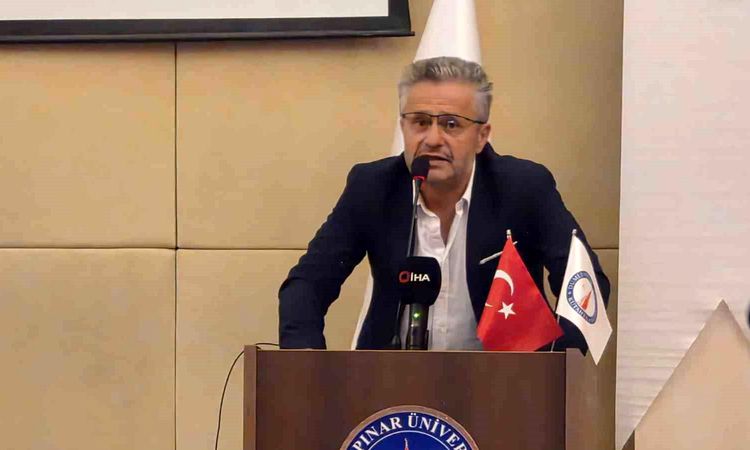
Speaking at the conference titled "Our Will, Our Victory" organized by Kütahya Dumlupınar University within the scope of July 15 Democracy and National Unity Day, Dr. Evaluating Türkiye's coup history from a historical perspective, Lütfü Özşahin said that July 15 was the greatest struggle for democracy waged by the will of the nation against coup plotters.
The conference titled "Our Will, Our Victory" organized by Kütahya Dumlupınar University (DPÜ) within the scope of the July 15 Democracy and National Unity Day commemoration events was held with intense participation. Dr. was a speaker at the conference, which attracted the attention of academicians, students and guests. Lütfü Özşahin made comprehensive evaluations on Türkiye's coup history, foreign interventions, democracy awareness and the place of July 15 in Turkish political life.
Stating at the beginning of his speech that the military coups in Türkiye cannot be explained only by domestic political situations, Özşahin said that the coup attempts of 1960, 1971, 1980 and subsequent coup attempts also had an international dimension.
Arguing that the influence of the West was behind the coups, Özşahin said, "I think there is external support behind the military interventions that Türkiye has experienced, starting from the 1960 coup. These are not just attempts to change governments. The main goal is to prevent Türkiye from forming an independent political structure in line with its own historical and social values."
"It is not possible to understand the coups without understanding the Gladio structure"
In his speech, Lütfü Özşahin also touched upon the "Stay Behind" structures, known as "Gladio" and allegedly operating under different names in NATO countries, and said that these structures should be examined historically in order to understand the coup processes in Türkiye.
Stating that the structures in question are organized under different names in different countries, Özşahin claimed that their common goal is to drag the countries into political and social instability. Arguing that Türkiye has been tried to be made open to foreign interventions for many years due to its geopolitical location, Özşahin stated that evaluating coups only as changes in political power would be an incomplete perspective.
"A politician who does not know history is like a ship captain without a compass."
Drawing attention to the importance of historical awareness in order to analyze coup processes correctly, Dr. Özşahin reminded Ottoman statesman and historian Ahmet Cevdet Pasha's words: "A politician who does not know history is like a ship captain who does not know a compass."
Stating that Türkiye's history of coups has not been analyzed sufficiently, Özşahin stated that this process should be addressed in a multifaceted manner through academic activities.
Continuing his speech, Özşahin stated that the social basis that made coups possible in Türkiye should also be examined, and said that universities bear an important responsibility in this regard.
Stating that Türkiye has faced economic and military embargoes for many years, Özşahin argued that this situation negatively affects the development of both the state and society.
Stating that the individualization process targeted by the Republic could not be fully realized, Dr. Lütfü Özşahin stated that the coupist structures within the army could not be detected for many years due to the trust the society had in the Turkish Armed Forces.
Emphasizing that the Turkish army has been an institution integrated with the nation throughout history, Özşahin said that the army can never point a gun at its nation.
"The Turkish army was born from the heart of the nation. The owner of the army is the nation itself. This nation buys the army's weapons, planes and tanks. Therefore, no structure, no clique can turn the weapons obtained with the nation's means to this nation," said Özşahin, adding that the coup attempts did not represent the army.
Özşahin said that the coup attempt on July 15, 2016 was a historical breaking point for Türkiye and stated that the nation directly resisted the coup plotters for the first time.
Stating that July 15 was not only a failed coup attempt, but also a historical struggle in which the will of the nation was re-asserted, Özşahin said:
"On July 15, the nation, together with its state, claimed its own will. The mask of the coup plotters fell. The nation took a historic stance against the coup plotters by defending democracy and elected government."
Describing July 15 as "Anatolian Independence" in one of the most striking parts of his speech, Özşahin made the following assessment: "July 15 is not only the prevention of a coup attempt. It is also the day when the nation saved its own will, integrated with its state and stood up against the coup plotters. In this respect, it is an Anatolian independence. From the perspective of democracy, it is an Anatolian revolution in the sense of strengthening the Republic."
Lütfü Özşahin stated that social awareness against the concept of coup increased significantly in Türkiye after July 15, and from now on, no coup plotter structure, regardless of political views, will be able to easily target the will of the nation.
At the end of his speech, Özşahin touched upon the deep traces left by past coups on society, and reminded that Prime Minister Adnan Menderes was executed after the 1960 coup and that right- and left-wing young people faced executions in different periods, and said that coups cannot be legitimized on any grounds.
Stating that no political or social justification can justify pointing a gun at the elected government, Özşahin concluded his speech by stating that the sufferings experienced during the coup periods contain important lessons in Türkiye's history of democracy. - KUTAHYA