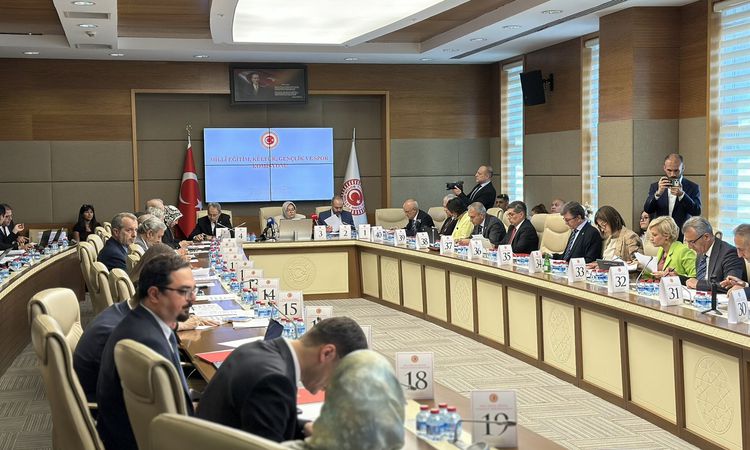
The National Education, Culture, Youth and Sports Commission of the Turkish Grand National Assembly convened to discuss the 'Proposal Law on Amendments to the Higher Education Law and Some Laws', which also includes regulations regarding student amnesty.
The National Education, Culture, Youth and Sports Commission of the Turkish Grand National Assembly convened under the chairmanship of AK Party Eskişehir Deputy Ayşen Gürcan. AK Party Kocaeli Deputy Sadettin Hülagü, who was the first signatory on the proposal, gave information about the proposal. Stating that the proposal consists of 28 articles, Hülagü said, "With this proposal we have prepared, it is aimed to eliminate the problems that arise in the functioning of our higher education institutions, to implement the legal regulations needed in line with judicial decisions, and to strengthen the scientific and institutional capacity of our universities. This bill, which we have presented to our Presidency of the Parliament, is the product of a comprehensive activity that focuses on the right to education of our students, the labor of our academics, the functioning of our university hospitals and taking our higher education quality even further. Our country has achieved an important situation in the field of higher education in recent years. It has reached a strong point in terms of the number of staff and students, program diversity, publication potential and international student capacity. Our universities now have the potential to carry out education and research activities not only in our country but also abroad. Developing international relations have increased the demands for cooperation in the field of higher education from friendly and relative countries, and cooperation protocols have been signed with some countries in the Balkans, the Middle East and Africa. According to the protocols, our universities will carry our knowledge and experience in the field of higher education to the countries with which we have close cooperation. "The interaction will be strengthened," he said.
'STUDENT AMNESTY REGULATION WILL BE IMPLEMENTED'
Hülagü made evaluations about the articles of the proposal and said, "The opportunity to return to education in higher education is very important for students. With this proposal, the maximum duration of students has been rearranged by taking into account the structure of all programs such as applied education and internships, the hesitations that arise in practice are eliminated, and it is aimed to protect the right to education with transition provisions for students who are dismissed. It is aimed to protect the right to education for students who are dismissed for various reasons while they are studying at associate, undergraduate, graduate level and postgraduate level, including preparatory classes, in higher education institutions. Student amnesty regulation will be implemented. Our students will be given the opportunity to start their education in the 2026-2027 academic year, provided that they do not benefit from previous amnesties, if they apply to the higher education institution where their relations were terminated or where they gained the right to enroll within 4 months. In addition, in order to avoid being victimized by the military service on the date of entry into force of the article, students will be able to benefit from the rights specified in this article if they apply to the relevant higher education institution within 2 months following their discharge. "It also provides a new opportunity to those who have applied education and applied education, and with the amnesty regulation, our students who have been successful in theoretical and practical courses but have not started or completed practical education and internship training are offered the opportunity to complete their practical and internship training," he said.
'PERSONAL RIGHTS OF RETIRED FACULTY MEMBERS ARE PROTECTED'
Noting that lecturers who retire due to age limits can continue their duties on a contractual basis and benefit from the same rights as their colleagues, Hülagü said, "With our proposal, the personnel rights of faculty members are protected if they are employed on a contractual basis after retirement. The continuity of their benefit from additional course fees, development and academic incentive funds is ensured. The age period here is extended from 67 to 75, with 2-year contractual periods. Strengthening the Technology Transfer Offices is of great importance in terms of R&D. For this reason, project-based in universities "We are strengthening the role of Technology Transfer Offices, which were established to support the production of knowledge and the transformation of knowledge into technology. The commercialization of inventions resulting from scientific activities is also very important. If the necessary conditions are met, the law allows the transfer of the rights to the inventions on behalf of the Technology Transfer Office."
'STATE INSTITUTIONS OF HIGHER EDUCATION WILL BE ABLE TO ESTABLISH FACILITIES ABROAD'
Hülagü stated that with the proposal, foundation universities can also benefit from full scholarship education incentives and continued as follows;
"The period regarding the obligation of foundation universities, which do not have their own hospitals within medical faculties, to have a hospital is also being extended. In addition, in line with the annulment decision of the Constitutional Court, the administrative sanctions and measures to be applied to foundation higher education institutions are being rearranged in accordance with the principles of proportionality and proportionality. In addition, the opportunity to assign faculty members to joint application and research centers is provided in order to support R&D activities that will contribute to the scientific and technological situation. Our professors within the higher education institution who will go abroad will be given the opportunity to be assigned for up to 5 years. "With the decision of our President, public higher education institutions in Türkiye are given the opportunity to establish campuses, academic units, programs and other needed facilities abroad. It is aimed that the academic units opened will serve as a bridge between countries in the field of education, research and scientific cooperation, and provide alternative education and training opportunities, especially for students who are citizens of the country they are located in."
After Hülagü's briefing, the meeting continues with the MPs' opinions and evaluations on the entire proposal.