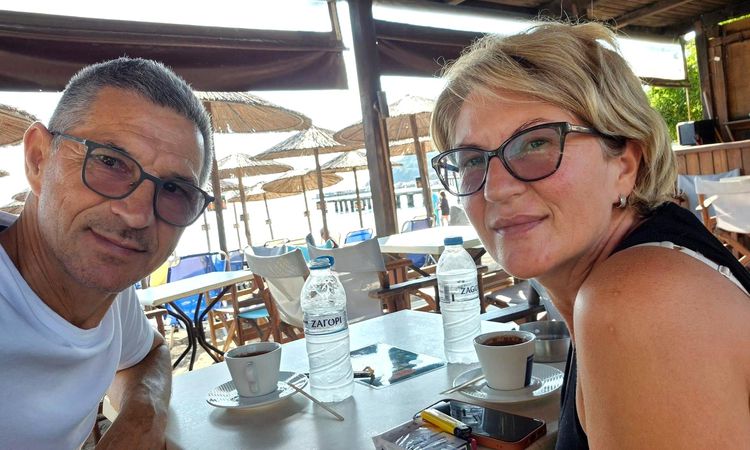
The wife of a passenger who was in danger of death due to a broken window on a Ryanair flight from Greece to Germany, described the moments when her husband held her legs, saying "half of his body was hanging out of the plane."
The Karovic couple were on the plane traveling from Thessaloniki to Memmingen, Germany.
Svetlana Grkovic told the Greek public broadcaster ERT about the horror her husband experienced.
He said his wife "went out of the plane up to her chest" and remained that way for about two minutes.
Grkovic said in an interview with Serbia-based Nova, "I hugged his legs without thinking. The only thing that crossed my mind at that moment was, 'If we are going to die, let's die together.'"
Grkovic said that they were able to pull his wife back into the cabin with the help of two other passengers. He stated that his wife lost consciousness three times during this time.
According to Grkovic, a part of the plane's engine broke off and hit the window next to his wife.
With the glass breaking, there was a sudden loss of pressure in the cabin. Other passengers also reported hearing a sound that sounded like a large explosion.
A technical consultant who gave information to the family evaluated that the incident started with a malfunction in the right engine of the plane, the broken pieces hit the cabin window and shattered the glass, which caused a sudden loss of cabin pressure.
However, this finding has not yet been confirmed by the authorities conducting the investigation.
Passengers had previously told the local press that the fact that Karovic did not remove his seat belt enabled other passengers to keep him inside.
Passengers stated that the belt saved him from being thrown completely out of the plane, even though his head and shoulders were sticking out of the plane.
Svetlana Grkovic said her 61-year-old husband was "seriously injured and in great shock".
"The most important thing for me is that he is alive... Especially his hand was seriously injured, he also has burns. He is not in a position to communicate right now and does not remember everything that happened," he said.
According to flight tracking data, the Ryanair plane suddenly lost altitude by 9,000 feet (about 2,700 meters) about 10 minutes after takeoff.
In a statement, Ryanair stated that the plane, which took off from Thessaloniki to Memmingen on Friday morning, July 10, turned back shortly after takeoff due to "a passenger window became dislodged during the flight."
In its statement, the Ireland-based airline said, "The plane landed normally and the passengers were taken back to the terminal. One passenger requested medical assistance and received medical attention in Thessaloniki."
Christina, one of the passengers on the plane, told Radio Thessaloniki, "We immediately realized that there was a loss of pressure in the cabin. Everyone was screaming. At first, I thought someone had opened the emergency exit door by mistake."
Another passenger, Sofia, told the same radio station, "We thought the plane was going to crash. The loss of pressure was very severe. We felt like we couldn't breathe. The injured man was bleeding and probably lost consciousness several times due to the shock he experienced due to lack of oxygen."
It is stated that the plane that experienced the incident was an 18-year-old Boeing 737-800 operated by Ryanair's subsidiary Malta Air.
Fraport Greece, the operator of Thessaloniki Airport, announced that the incident was investigated by the Greek Air and Railway Safety Investigation Agency.
According to local media, 61-year-old Karovic continues his treatment in the hospital. The investigation into the cause of the incident continues.
Since the plane was a US-made Boeing 737-800 and the incident occurred in North Macedonia's airspace, many international aviation institutions also support the investigation.
These include Boeing, the US Federal Aviation Administration (FAA) and the European Union Aviation Safety Agency (EASA).
Nikos Papanikolaou also contributed to the news.
We used artificial intelligence in the translation of this article, which was originally written in English. A BBC journalist checked the translation before publication. .