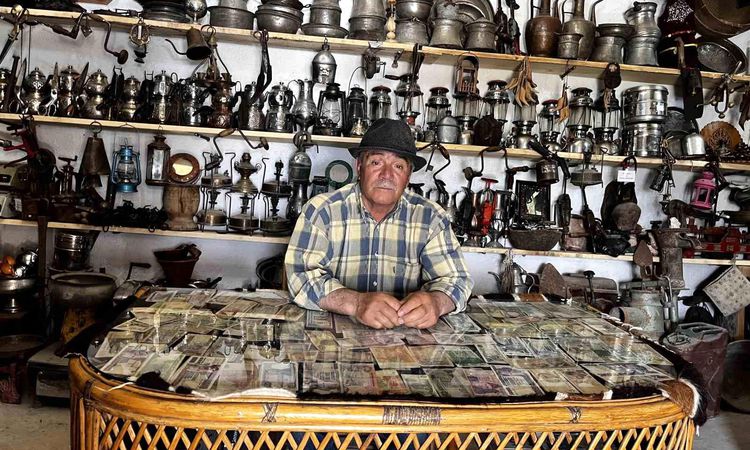
70-year-old retired Süleyman Erol in Niğde; When he saw that Turkish cultural artifacts were not exhibited at the historical Ottoman Train Station, the last stop of the Hejaz Railway, which he visited in Saudi Arabia, he decided to preserve the past. Erol, who has been collecting historical objects from everywhere he went for about 20 years, created a museum by exhibiting thousands of works in the area he built next to his house.
The cultural journey of retired railway employee Süleyman Erol, who lives in the Kulan village of Ulukışla district, started years ago in Saudi Arabia. Erol, who visited the historical Ottoman Train Station, the last stop of the Hejaz Railway, with great interest due to his retirement from the railways, said that many historical items from different countries were exhibited in the museum, but the lack of works belonging to the Ottomans and Turks deeply impressed him.
After this visit, Erol decided to protect the cultural heritage of the past and started collecting old agricultural tools, household items, handcrafted products and hundreds of historical objects used in daily life from different cities of Türkiye and every region he visited for about 20 years. Erol's collection, which displays his collected works in a special area next to his home, includes thousands of tools and items used by Anatolian people in their daily lives in the past. The area, which attracts great interest from visitors, is considered as a small museum by those who see it.
The deficiency he saw in Saudi Arabia changed his life
Explaining the process he went through, Süleyman Erol stated that the visit to Saudi Arabia was a turning point in his life; "I went to Arabia. I visited the Ottoman Train Station. Since I retired from the railways, it attracted my attention. There were historical artifacts from many countries in the rooms. French, British, German, American and Chinese were written on them, but I could not find even a single Turkish name. At that moment, I said to myself, 'I will serve this culture, I will keep this heritage alive as much as I can,'" he said. Erol explained that an incident he had with his grandchild reinforced his decision to collect; "My grandson, who is a doctor, took a heifer in his hand and asked, 'Grandpa, what is this wood?' he asked. However, heifer was an important part of our ancestors' lives. Young people today do not recognize these items. "That's when I realized once again how important it is to keep this culture alive," he said. Pointing out that the works he collected have more spiritual value than material value, Erol emphasized that these items, which made people's lives easier in the past, should be transferred to future generations.
It welcomes visitors from all over Türkiye
Erol said, "People manage to destroy culture very easily, but it is very difficult to preserve it. I chose the difficult one. I bought and protected all the old tools and equipment I could find so far. Their material value may be low, but their spiritual value is very high. Because these items gave life to our ancestors, they worked hard and provided production. When future generations see these, they will ask, 'Why did our ancestors use these?' he will wonder. "Our duty is to carry this legacy into the future," he said. Stating that visitors come from many provinces of Türkiye to see the collection, Erol said, "People from different cities of Türkiye visit this place and are amazed. No one knows what some of the items are used for anymore. That's why it is our duty to protect them. I sincerely want people like me to undertake this cultural work." - NIGDE