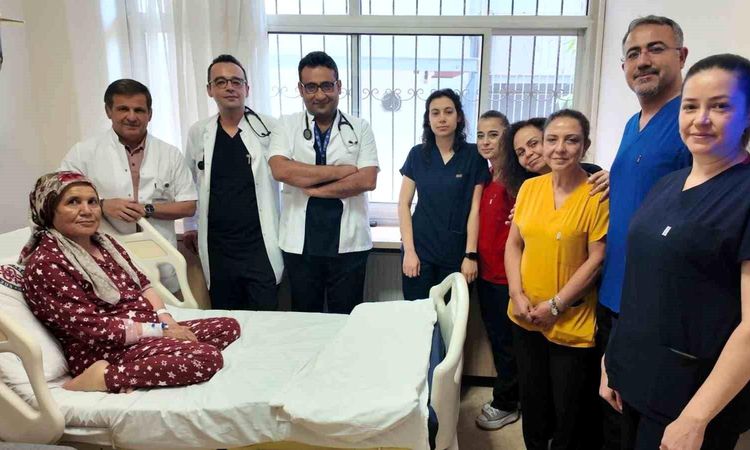
The Department of Cardiology, Faculty of Medicine at Ege University (EÜ) successfully performed a challenging cardiac intervention, rarely seen in medical literature, which required advanced teamwork and a multidisciplinary approach.
High-risk patient Raziye Çelik (68), who had both mechanical mitral and mechanical tricuspid valve prostheses and was also suffering from life-threatening severe aortic valve stenosis, was restored to health using the Transcatheter Aortic Valve Implantation (TAVI) method. The elderly woman, who had previously undergone three open-heart surgeries, found healing at Ege University.
This great success was achieved through the coordinated efforts of Prof. Dr. Mehdi Zoghi, Head of the Department of Cardiology, Faculty of Medicine at Ege University; proctor Prof. Dr. Engin Bozkurt, who guided the operation; Associate Professors Dr. Emre Demir, Dr. Bekir Serhat Yıldız, and Dr. Yaprak Tepeli, who performed the procedure; as well as the anesthesia team, nurses, technicians, and catheter laboratory staff.
Prof. Dr. Mehdi Zoghi, one of the physicians who performed the operation, stated, "As the Department of Cardiology at Ege University, we have achieved a great success. Together with my esteemed colleagues Associate Professor Dr. Emre Demir and Associate Professor Dr. Bekir Serhat, we successfully concluded a case rarely seen in medical literature. Although heart surgeries routinely continue in our clinic, significant developments have occurred in aortic valve surgery worldwide and in our country in recent years. This latest case of ours was quite special; we can say it is a first for Turkey. When we reviewed the literature, interventional treatment for aortic valve stenosis in a patient who had previously undergone three valve surgeries had only been recorded twice worldwide. We became the third case globally treated with this method. In this respect, our operation holds great importance. We achieved this success with a complete team spirit. With the support provided by the Ege University administration and the dedicated contributions of my colleagues, we completed the process smoothly."
Associate Professor Dr. Emre Demir, commenting on the operation, stated that the team meticulously performed the intervention after thoroughly evaluating the patient, expressing that both they and the patient were very pleased with the outcome.
Associate Professor Dr. Bekir Serhat, highlighting the success of the operation, emphasized that they successfully completed this procedure in a very rare case. Stating that the process was the result of collective effort, Associate Professor Dr. Serhat said, "Our esteemed Prof. Dr. Engin Bozkurt, who came from Ankara to support us during this process, also made significant contributions. This is not an individual achievement, but the product of challenging teamwork. We thank our administration, our department, and all our faculty members for providing us with all kinds of support."
Patient Raziye Çelik, speaking about her post-operative condition, said, "I had previously undergone three open-heart surgeries, and this was my fourth operation. Since two different valves were intervened in previous surgeries, undergoing another operation was considered quite risky. However, as a result of Emre Hoca's evaluations, a severe narrowing in my aortic valve was detected. Without the need for another open surgery, the valve was expanded thanks to a stent inserted through the groin. Currently, my breathing has improved, and I am doing very well. I thank all my doctors, especially Emre Hocam. I am very satisfied with my doctors, nurses, and the hospital."
The performed operation holds great importance in medical literature due to its clinical difficulty and rarity. According to current medical records, there are currently only two cases worldwide with mechanical valves in both mitral and tricuspid positions who have undergone a TAVI procedure. This third successful application performed by the Ege University team once again proved that with proper planning and strong teamwork in experienced centers, the TAVI method can be a safe and effective treatment option even for the highest-risk patients. - İZMİR