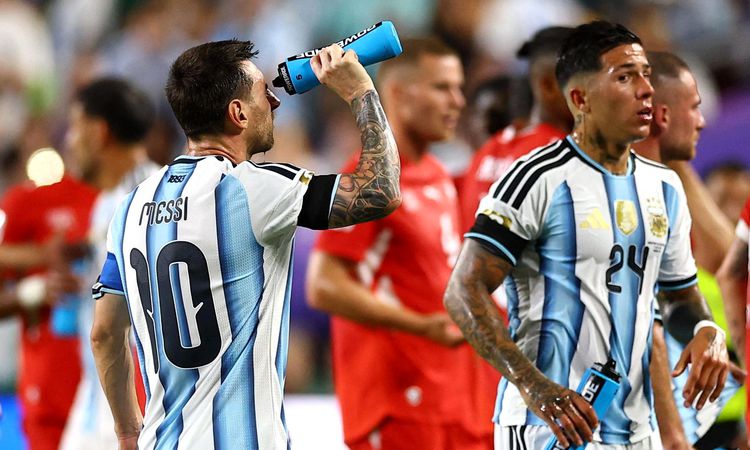
The "water break" analysis conducted before England's match against three-time world champion Argentina shows that the blue-whites are one of the teams that benefit most from these breaks.
The BBC World Service examined statistical analysis of 100 matches played from the group stage to the quarter-finals.
This analysis shows that controversial water breaks introduced by FIFA led to an unexpectedly high number of goals.
Three-minute water breaks halfway through both halves have been mandated in all 104 matches at the World Cup to help players cope with sweltering heat and humidity levels in Canada, Mexico and the United States.
Brennan Klein, a professor at Northeastern University in Boston, USA, says his analysis of data including shots on target and defensive actions shows that these breaks also create an unforeseen "five-minute jump" effect in the number of goals.
In the last three World Cups and in Europe's top-level leagues over the last decade, the period after the 76th minute was the period when the probability of a goal was highest.
In this tournament, this time corresponds to approximately six minutes after the end of the second water break.
Klein and his research team's analysis showed that the first five minutes after water breaks, that is, the 25-30th minute of the matches. and 70-75. He found that the period between minutes was a time period that normally produced much fewer goals.
Without water breaks, "we would expect around 27 goals [across 100 matches] to be scored in those five-minute periods," Klein says.
But that number has risen to 38 in this World Cup, the first tournament to mandate such breaks in every match.
In fact, 27 of the 48 teams in the tournament scored a goal within five minutes of the water break.
The team that benefited most from this effect was Argentina, which scored three goals and conceded no goals.
The team that benefited the least from this was England, who scored only one goal.
Today, as these two teams duke it out in the semi-finals, the effect of the water breaks will be followed with interest.
What is more interesting is that Klein also revealed that this five-minute jump cannot be explained by an increase in the number of shots on goal.
Instead, shots were more likely to find the target.
"The shots sent towards the goal are of higher quality than normal in the first five minutes. For example, they are taken from points closer to the goal," he says.
Water breaks were largely unpopular and fans often booed when these breaks were announced in stadiums.
FIFA was also accused of creating a secret advertising break during matches.
It is stated that US television broadcasters are expected to earn an additional $250 million in revenue from advertisements broadcast during these periods when the game is stopped.
Critics also argue that these breaks disrupt the flow of the game. But Klein didn't see that in the data.
There was no increase in the number of "press actions per minute".
And this increase could not be explained by the defenders being caught off guard.
"If the defenders came back into the game cold, you'd expect better opportunities and more mistakes [for the attackers]," says Klein.
“In fact, such situations occur less frequently immediately after breaks.
"It's not about the defenders sleeping, but about the attackers being sharper."
It was seen that the coaches gave all kinds of instructions to the players during water breaks.
But Klein says: "The data does not show any coach as a 'timeout master'."
"The honest answer is that good teams can score goals every minute."
We used artificial intelligence in the translation of this article, which was originally written in English. A BBC journalist checked the translation before publication. .